
When parents separate, many decisions about their children’s lives become more complicated. One issue that often creates conflict is deciding where a child will go to school. Whether the disagreement involves a public school, charter school, private school, online program, homeschooling, or special education services, parents frequently ask what Arizona law requires and who has the authority to make educational decisions.
While school choice disputes can become emotional, it is important to remember that Arizona family courts focus primarily on the child’s well-being and long-term success. Every parent wants their child to have opportunities, feel supported, and receive a quality education. Even when parents disagree about the path forward, keeping the child’s future at the center of the discussion often creates opportunities for cooperation and better outcomes.
Table of Contents
- Understanding School Choice Disputes in Arizona
- How Joint Legal Decision-Making Affects Educational Decisions
- What Happens When Parents Cannot Agree on a School?
- Public Schools, Charter Schools, Private Schools, and Homeschooling
- IEPs, Special Education Services, and Educational Advocacy
- How Arizona Courts Determine What Is Best for the Child
- Mediation and Resolving School Choice Disputes Outside of Court
- Real Arizona Examples of School Enrollment Disputes
- Frequently Asked Questions
- Contact the Law Offices of Daniel Hutto
This article explains how the Law Offices of Daniel Hutto handles school choice disputes, what happens when parents share joint legal decision-making, how courts evaluate educational disagreements, and what parents can do to advocate for their children’s educational needs. Whether your child attends a public, charter, or private school, receives special education services through an IEP, or is being considered for homeschooling, understanding your rights and responsibilities can help you make informed decisions and protect your child’s future.
How an Arizona Family Law Attorney Can Help
Our Phoenix Family Law Attorneys are Here to Help!

Understanding School Choice Disputes in Arizona
School choice disputes occur when parents disagree about where a child should attend school or how educational decisions should be made. These disagreements can arise during a divorce, after a custody order has already been entered, or years after parents have established a parenting plan.
Arizona offers families numerous educational options. A child may attend:
- Traditional public schools
- Charter schools
- Private schools
- Online schools
- Homeschool programs
Because Arizona provides so many choices, disagreements can arise even when both parents genuinely want what is best for their child.
For example, one parent may believe a charter school offers stronger academic opportunities and wishes to enroll the child there. The other parent may prefer the child’s current school because it provides stability and established friendships. Another dispute may involve whether private school tuition is worth the cost or whether homeschooling would better serve a child’s educational needs.
These situations often become difficult when parents share joint legal decision-making authority because neither parent has unilateral authority to make major educational decisions.
Arizona courts recognize that education plays a significant role in a child’s development, which is a key factor in custody agreements. School placement decisions can affect academics, extracurricular activities, friendships, transportation, special education services, and future opportunities. As a result, courts take these disputes seriously and focus on the child’s best interests rather than either parent’s personal preferences.
How Joint Legal Decision-Making Affects Educational Decisions
Arizona no longer uses the term “custody” in the traditional sense. Under A.R.S. § 25-401, legal decision-making refers to a parent’s authority to make major decisions regarding a child’s education, healthcare, religion, and personal care.
Many Arizona parents share joint legal decision-making authority under A.R.S. § 25-403.01 outlines factors that courts consider in determining the best interests of the child. Joint legal decision-making means both parents participate in making important decisions affecting their child.
Educational decisions are considered major decisions. This means parents with joint legal decision-making generally must work together regarding:
- School enrollment
- School transfers
- Charter school applications
- Private school attendance
- Homeschooling decisions
- IEP participation
- Educational accommodations
- Significant academic programs
A common misconception is that the parent with more parenting time automatically controls school decisions. This is usually not true.
A parent may have primary residential time while still sharing joint legal custody and decision-making authority equally with the other parent. Unless a court order specifically grants one parent final authority regarding education, both parents generally must participate in educational decisions.
When parents share joint legal decision-making, communication becomes critical. Parents who can maintain respectful communication often avoid costly court battles while creating better educational outcomes for their children.
What Happens When Parents Cannot Agree on a School?
Sometimes parents simply cannot agree.
One parent wants a charter school. The other wants a neighborhood public school. One parent supports private education. The other parent opposes paying tuition, which can complicate the custody agreement and child support discussions. One parent wants to homeschool while the other believes traditional classroom instruction is necessary.
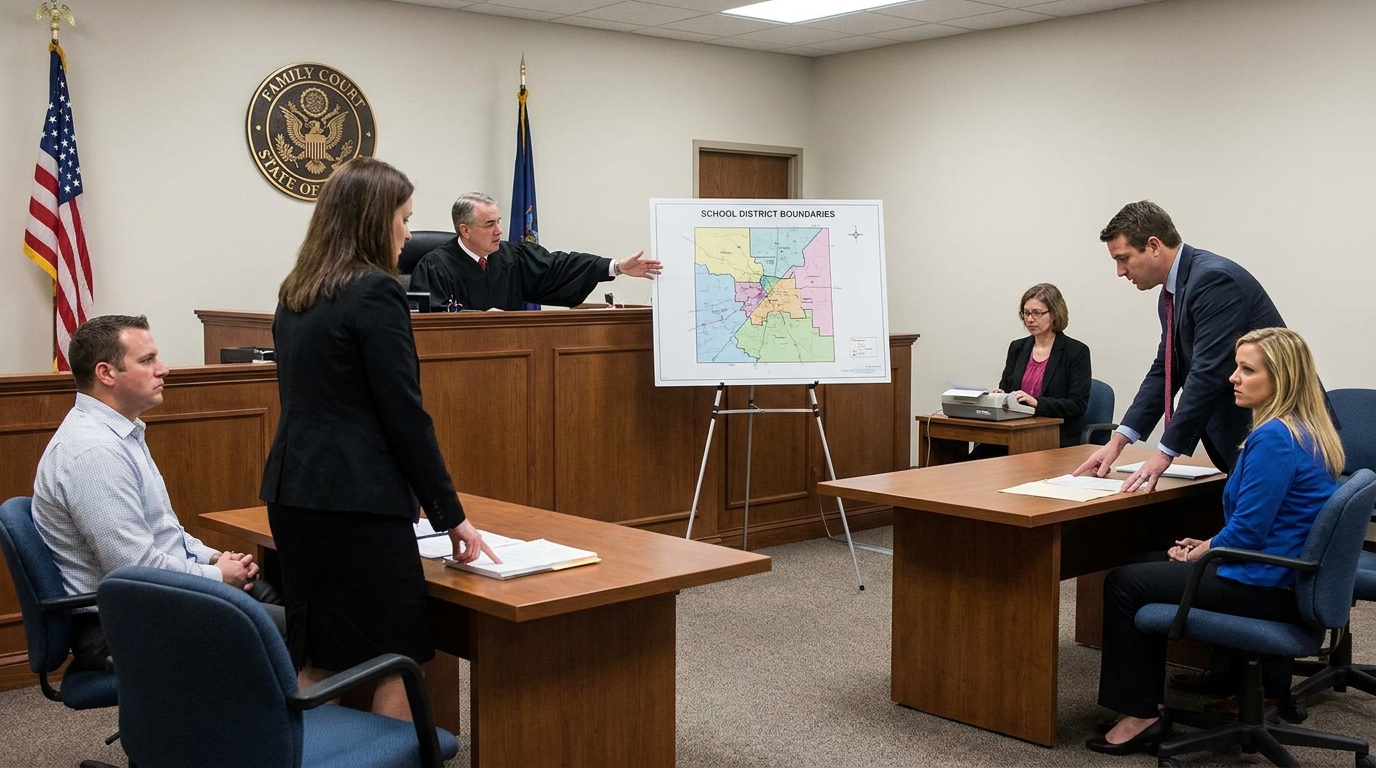
When parents cannot agree, Arizona family courts may become involved.
Often, the court will require mediation before scheduling a hearing. Mediation provides an opportunity for parents to discuss concerns and seek compromise with the assistance of a neutral third party.
If mediation fails, either parent may file a motion asking the court to resolve the dispute.
The judge will review evidence concerning:
- Academic performance
- School rankings
- Transportation concerns
- Special educational needs
- Extracurricular opportunities
- Stability and continuity
- Distance between homes
- Existing friendships and support systems
The court’s focus is not on determining which parent is right, but rather on the interests of the child. Instead, the court evaluates which educational arrangement serves the child’s best interests under A.R.S. § 25-403.
Parents should understand that litigation can be stressful and expensive. Whenever possible, cooperative problem-solving usually benefits both the child and the family.
Public Schools, Charter Schools, Private Schools, and Homeschooling
Arizona families have more educational choices than those in many states.
Public Schools
Traditional public schools remain the most common option. Public schools often provide consistency, transportation options, extracurricular activities, and special education services.
Charter Schools
Arizona has one of the nation’s largest charter school systems.
Many parents choose charter schools because of specialized academic programs, smaller class sizes, or educational philosophies that align with family goals.
Private Schools
Private schools may offer religious instruction, advanced academic programs, or specialized educational environments.
However, private school disputes often involve tuition costs that can affect child support negotiations. Courts frequently consider who will pay tuition and whether the educational benefits justify the expense.
Homeschooling
Homeschooling has become increasingly popular throughout Arizona.
Many parents choose homeschooling because it allows individualized instruction and flexible scheduling. Homeschooling can be especially attractive for children with unique learning needs, athletic commitments, or health concerns.
However, homeschooling often creates significant disagreement when parents share joint legal decision-making.
If one parent wants to homeschool and the other opposes the idea, court involvement may become necessary.
Judges may consider:
- Academic plans
- Curriculum quality
- Socialization opportunities
- Parent qualifications
- Child’s educational history
- Long-term educational goals
Homeschooling is not automatically favored or disfavored. Courts evaluate whether the proposal serves the child’s best interests, taking into account all aspects of the custody agreement.
IEPs, Special Education Services, and Educational Advocacy
Some of the most important school choice disputes involve children who receive special education services.
An Individualized Education Program, commonly called an IEP, is a legally required plan developed for eligible students with disabilities under federal law.
Parents frequently disagree regarding:
- IEP services
- Therapy recommendations
- Classroom placements
- School districts
- Specialized educational programs
- Private special education schools
When a child has an IEP, cooperation becomes especially important.
Children facing learning challenges often need consistent support both at school and at home, which is crucial in any custody case. Conflict between parents can create additional stress that interferes with educational progress.
Arizona courts frequently recognize that children with special educational needs benefit when parents work together as advocates rather than opponents.
A child who sees both parents attending IEP meetings, communicating respectfully with educators, and supporting educational goals receives a powerful message: “We may not agree on everything, but we are united when it comes to your future.”
That type of unity often becomes one of the most valuable educational supports a child can receive.
Parents should remember that disagreements with each other should never interfere with helping a child access services, accommodations, therapy, or educational opportunities that support long-term success.
Sometimes the greatest victory is not winning an argument. Sometimes it is finding enough common ground to help a child thrive.
How Arizona Courts Determine What Is Best for the Child
Under A.R.S. § 25-403, Arizona courts evaluate numerous factors when making decisions involving children.
The court may consider:
- The child’s adjustment to school
- Educational stability
- Relationships with teachers and peers
- Special educational needs
- Parent involvement
- Ability of parents to cooperate
- The child’s wishes, when appropriate
- Long-term educational opportunities
Judges often place significant weight on maintaining stability, especially when a child is already succeeding academically and socially.
Frequent school changes can create disruption. Courts may hesitate to change schools without a compelling reason.
At the same time, courts recognize that change may be appropriate when a new educational option better serves the child’s needs.
The guiding principle remains simple: what arrangement best promotes the child’s educational, emotional, and developmental well-being, in line with the child’s interests?
Mediation and Resolving School Choice Disputes Outside of Court
Not every disagreement over a child’s education needs to end with a courtroom hearing. In many Arizona family law cases, mediation gives parents the opportunity to discuss school choice concerns in a structured setting with the help of a neutral third party. Mediation encourages productive communication and often leads to solutions that both parents can support, while reducing the financial and emotional costs of litigation.
Arizona courts frequently encourage or require mediation before hearing contested legal decision making issues. During mediation, parents can discuss concerns about public schools, charter schools, private school tuition, homeschooling, transportation, special education services, extracurricular activities, and other educational matters. Rather than having a judge make the decision, parents retain greater control over the outcome by working together to find common ground.
Successful mediation often begins with focusing on shared goals instead of personal disagreements. While parents may have different opinions about which school is best, most share the same objective of helping their child receive a quality education and build a successful future. Keeping conversations centered on the child’s academic progress, emotional well being, friendships, and long term development can help move discussions in a positive direction.
Parents may also benefit from gathering objective information before mediation. School performance reports, teacher recommendations, standardized test scores, IEP evaluations, transportation logistics, and financial considerations can all provide helpful facts that support meaningful discussions. Decisions based on reliable information rather than emotion often lead to more lasting agreements.
Attorney Daniel Hutto and the family law team at the Law Offices of Daniel Hutto regularly help parents prepare for mediation by identifying the strengths of their position, gathering supporting evidence, and developing practical solutions that place the child’s needs at the center of every discussion. Even when complete agreement is not possible, mediation frequently narrows the issues that require court intervention, saving families time, stress, and expense.
Real Arizona Examples of School Enrollment Disputes
Every family’s situation is different, but many school choice disputes involve similar issues. The following examples illustrate how educational disagreements can arise and how Arizona family courts may approach them.
Example 1: Charter School Versus Neighborhood Public School
Parents share joint legal decision making following their divorce. The mother wants to enroll their daughter in a highly rated charter school located thirty minutes from both homes. The father prefers keeping her in the neighborhood public school, where she has attended for several years, has close friends, and participates in after school activities.
If the parents cannot reach an agreement through mediation, the court may consider factors such as the child’s academic performance, transportation demands, stability, extracurricular involvement, and whether changing schools would meaningfully improve the child’s educational opportunities. The judge will focus on the child’s best interests rather than simply choosing one parent’s preferred school.
Example 2: Homeschooling a Child With Special Educational Needs
A child diagnosed with learning disabilities currently receives services through an Individualized Education Program at a public school. One parent believes homeschooling would allow more individualized instruction, while the other believes the child benefits from specialized teachers, speech therapy, and daily interaction with classmates.
In this situation, the court may review educational evaluations, testimony from teachers or specialists, the proposed homeschool curriculum, available therapies, and the child’s educational progress. The judge will evaluate whether the proposed educational setting adequately supports the child’s unique learning needs while promoting continued academic and social development.
These examples show that Arizona courts do not automatically favor one educational option over another. Instead, each case is decided based on its own facts and the educational arrangement that best supports the child’s overall well being.
Frequently Asked Questions
1. Can one parent change a child’s school without the other parent’s permission?
If parents share joint legal decision making authority, major educational decisions generally must be made together. Unless a court order gives one parent final authority over educational decisions, one parent should not unilaterally change a child’s school without the other’s agreement.
2. Does the parent with more parenting time get to choose the school?
Not necessarily. Parenting time and legal decision making are separate issues under Arizona law. A parent may have the majority of parenting time while both parents continue to share equal authority over major educational decisions.
3. What happens if mediation does not resolve our disagreement?
If mediation is unsuccessful, either parent may ask the family court to decide the issue. The judge will consider evidence from both parents and determine which educational arrangement serves the child’s best interests under Arizona law.
4. Can a judge order a child to attend private school?
Yes, although private school is not automatically preferred. The court may approve private school attendance if the evidence shows it is in the child’s best interests. The court may also address how tuition and related educational expenses will be paid.
5. How are homeschooling disputes handled?
When parents disagree about homeschooling, the court evaluates the proposed educational plan, curriculum, academic goals, social opportunities, and the child’s individual needs. Homeschooling is considered alongside all other educational options based on what best serves the child.
6. How do IEPs affect child custody disputes?
Children with IEPs often require ongoing cooperation between parents to ensure they receive appropriate educational services and accommodations. Courts recognize the importance of maintaining consistency and encouraging both parents to participate in educational planning whenever possible.
7. When should I contact a family law attorney about a school dispute?
You should consider speaking with an attorney as soon as it becomes clear that you and the other parent cannot reach an agreement. Early legal guidance can often help resolve disagreements before they become expensive court battles. Attorney Daniel Hutto and the family law team at the Law Offices of Daniel Hutto help Arizona parents protect their parental rights while working toward educational solutions that place their child’s future at the center of every decision.
Contact the Law Offices of Daniel Hutto

School choice disputes are rarely just about buildings, teachers, or school districts. They often reflect deeper concerns about a child’s future, opportunities, and well-being. When parents disagree about education, emotions can run high because both parents care deeply about their child.
At the Law Offices of Daniel Hutto, we understand that educational decisions can have lasting effects on a child’s life. Attorney Daniel Hutto and Partner John Carbone have extensive experience helping Arizona families resolve legal decision-making disputes, parenting plan conflicts, and complex child custody matters throughout the state.
John Carbone’s background as an Assistant Attorney General representing the Arizona Department of Child Safety provides valuable insight into how courts evaluate issues affecting children’s welfare. Combined with Daniel Hutto’s extensive family law experience, our team works to help parents find practical solutions while protecting their children’s best interests.
Whenever possible, we encourage parents to focus on cooperation rather than conflict. Children benefit when parents can set aside personal disagreements and unite behind educational goals. Whether the issue involves public school enrollment, charter schools, private school tuition, homeschooling, IEP services, or special education advocacy, we help parents pursue solutions that support their child’s future.
If you are facing a school choice dispute, contact the Law Offices of Daniel Hutto for a free one-on-one consultation. Call 602-560-5644 to learn how we can help protect your parental rights while keeping your child’s education and future at the forefront of every decision.


