
Military service can create unique challenges for parents involved in an Arizona custody case. A deployment, mobilization, activation, or temporary duty assignment may make it difficult for a military parent to follow a regular parenting-time schedule, attend a court hearing in person, or remain physically present in the child’s daily life.
Arizona law recognizes that military deployment can temporarily change a parent’s ability to exercise parenting time and participate in legal decision-making. At the same time, deployment by itself is not supposed to permanently eliminate a parent’s relationship with a child.
Under A.R.S. § 25-411, Arizona provides specific protections for military families when deployment or mobilization affects an existing custody order. The statute addresses temporary custody arrangements, military family care plans, electronic participation in hearings, delegation of parenting time in certain circumstances, and the transition back to the pre-deployment arrangement.
Arizona law also works alongside federal law. The Servicemembers Civil Relief Act includes specific child custody protections for a service member whose military duties affect a custody proceeding. Under 50 U.S.C. § 3938, a court generally cannot use deployment or the possibility of deployment as the sole factor in determining the best interest of the child in a permanent custody modification. The federal law also places limits on temporary custody orders based solely on deployment.
For military families, understanding these protections can be important before a parent receives deployment orders and after the parent returns home. A carefully structured custody order or temporary arrangement may help reduce uncertainty for both parents and the child.
Here’s what this article will cover:
- Arizona Family Law and Military Deployment
- How Arizona Law Protects a Military Parent
- Temporary Custody During Deployment
- Military Family Care Plans and Custody in Arizona
- Delegating Parenting Time During Deployment
- Electronic Participation in Arizona Courts
- What Happens When Deployment Ends?
- Deployment, Relocation, and Existing Custody
- Federal Protections for Military Parents
- What the Nondeployed Parent Should Know
- Frequently Asked Questions About Military Custody
- Important Things to Remember
- How the Law Offices of Daniel Hutto Can Help
How an Arizona Divorce Attorney Can Help
Our Phoenix Divorce Attorneys are Here to Help!
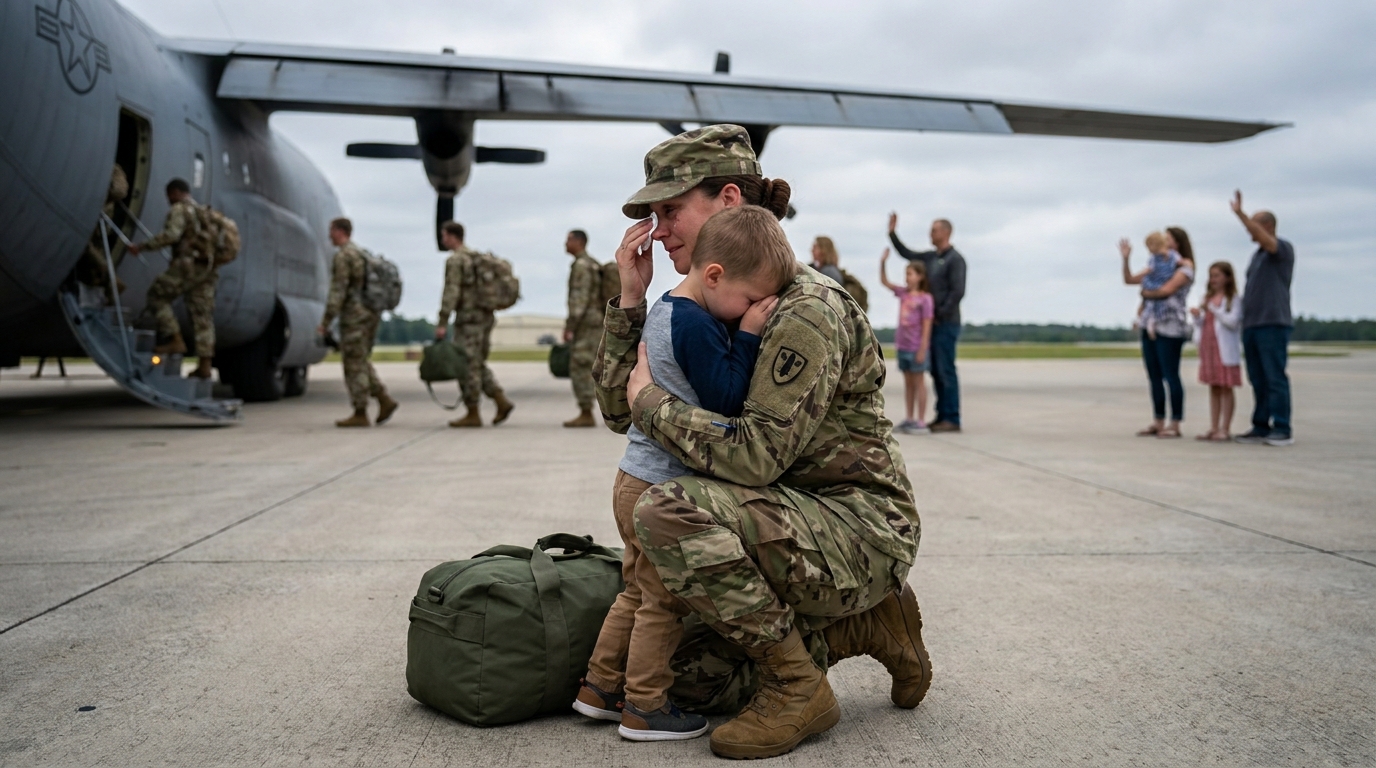
Arizona Family Law and Military Deployment
Arizona family law generally recognizes the importance of maintaining a parent and child relationship when doing so is consistent with the child’s needs and best interests.
Under A.R.S. § 25-403, Arizona courts determine legal decision-making and parenting time according to the best interest of the child. The statute directs the court to consider relevant circumstances involving the child’s physical and emotional well-being. Those factors include the past, present, and potential future relationship between the parent and child, the child’s adjustment to home and school, the child’s wishes when appropriate, and which parent is more likely to support meaningful and continuing contact with the other parent.
Military service can complicate those considerations.
A parent may receive orders requiring them to:
These circumstances can affect transportation, school schedules, holidays, exchanges, communication, and the parent’s ability to attend court.
Arizona law therefore provides specific rules for military families instead of treating every deployment as an ordinary custody change.
Deployment does not automatically end parental rights
One of the most important protections appears in A.R.S. § 25-411(C).
Arizona law provides that a parent’s absence caused by deployment or mobilization, or the possibility of future deployment or mobilization, cannot by itself be the sole factor supporting a finding of a real, substantial, and unanticipated change in circumstances.
This matters because a military parent may be physically absent without choosing to reduce their involvement in their child’s life.
The law recognizes the difference between a temporary absence caused by military obligations and circumstances that independently justify a permanent custody change.
For a parent facing deployment, that distinction can be important when discussing existing custody arrangements with an attorney.
How Arizona Law Protects a Military Parent
The military-specific provisions in A.R.S. § 25-411 provide several important protections for a service member.
The protections can apply when deployment, mobilization, activation, or temporary duty materially affects a parent’s ability to exercise parenting time or other parental responsibilities.
These protections do not guarantee a particular custody outcome. Arizona courts still consider the circumstances of the individual case and the child’s best interests.

Temporary Custody During Deployment
A military deployment may make an existing parenting schedule impractical.
For example, imagine that a service member has parenting time every other weekend but receives orders for a nine-month overseas deployment. The parent cannot physically exercise the ordinary weekend schedule while stationed thousands of miles away.
That does not necessarily mean the parent’s relationship with the child should simply disappear.
Under A.R.S. § 25-411(D), a deploying or non-deploying military parent may request a temporary order when the statutory requirements are satisfied.
Generally, the statute addresses circumstances in which:
After a hearing, the court is required to enter a temporary order modifying parental rights and responsibilities or parent-child contact during the period of deployment or mobilization.
Why temporary custody arrangements matter
A temporary order can give both parents a clearer understanding of what should happen while the military parent is away.
Depending on the circumstances, the order may address:
A written custody order can be especially important when parents disagree about the appropriate custody arrangements.
Rather than relying on informal promises, a parent can discuss the situation with a child custody attorney and determine whether temporary custody arrangements or a modification of parenting time should be requested.
Military Family Care Plans and Custody in Arizona
A family care plan can be especially important when a military parent is preparing to deploy.
Under A.R.S. § 25-411(A), when a parent is a member of the United States armed forces, the court must consider the terms of that parent’s military family care plan when determining the child’s best interests during military deployment.
The plan may help demonstrate how the service member intends to address childcare and family responsibilities while performing military duties.
For a parent preparing to deploy, it can therefore be useful to understand how the military family care plan interacts with an existing custody order.
What a military parent should review before deployment
A parent may want to gather:
The purpose is not simply to create paperwork. A clear plan can help Arizona courts understand how the child’s daily needs will be addressed while the service member is away.
Delegating Parenting Time During Deployment
One of the more specific protections available to a military parent involves the possible delegation of parenting time.
Under A.R.S. § 25-411(G), when temporary duty, deployment, activation, or mobilization substantially affects a military parent’s ability to exercise parenting time, the court may, at the military parent’s request, delegate some or all of that parenting time during the parent’s absence.
The court must determine that the arrangement is in the child’s best interest.
A person receiving delegated parenting time may include:
However, delegated parenting time does not automatically create independent parental rights.
Arizona law specifically provides that a court order delegating parenting time does not establish separate parenting-time rights for a person who is not a parent.
Why delegated parenting time can help
Deployment can be difficult for a child, particularly when a parent will be unavailable for an extended period.
A trusted relative may help maintain familiar family relationships and routines.
For example, a child may have a close relationship with the military parent’s parents. During deployment, regular contact with those grandparents may provide continuity while the parent is away.
The arrangement is not automatic, however. The court must determine that it is in the child’s best interests.
Electronic Participation in Arizona Courts
Military deployment can create practical problems when a parent needs to participate in an Arizona custody case.
A service member stationed overseas may not be able to travel back to Arizona for every hearing involving parenting time.
A.R.S. § 25-411(E) addresses this situation. When reasonable advance notice is provided and good cause is shown, the court must allow a deploying parent to present testimony and evidence by electronic means concerning certain parenting-time or parent-child-contact matters when deployment materially affects the parent’s ability to appear in person.
The statute identifies telephone and video teleconference as forms of electronic participation.
A parent should not simply assume that a hearing will be postponed because of military service.
Instead, the parent should address the issue through the appropriate legal process and provide the required notice and supporting information.
Deployment-related hearings
Arizona law specifically states that the court shall hear motions for modification because of deployment as expeditiously as possible. This can be important when a parent receives orders shortly before leaving.
A military parent facing deployment should consider addressing custody matters early enough to allow the court to establish appropriate temporary arrangements before the parent leaves.
What Happens When Deployment Ends?
Temporary custody arrangements are not necessarily intended to become permanent.
Arizona law specifically addresses the transition home.
Under A.R.S. § 25-411(H), temporary modification orders must include a specific transition schedule designed to facilitate a return to the predeployment order within 10 days after the deployment ends, while considering the child’s best interests.
This provision can provide an important framework for a military parent returning home.
A transition schedule may address
The return home can be a significant adjustment for both the parent and child. A parent may have been away for months and may need to reestablish routines.
A specific transition schedule can reduce uncertainty and provide both parents with clear expectations.
Overseas deployment and future custody arrangements
Arizona law provides another specific protection when a court enters a decree or order in contemplation of or during a military deployment outside the continental United States.
Under A.R.S. § 25-411(I), the order must specifically reference the deployment and include provisions governing legal decision-making or parenting time after the deployment ends.
Either parent may later petition the court to modify the order, and the statute requires the court to hold a hearing or conference within 30 days after the petition is filed.
Deployment, Relocation, and Existing Custody
Military service can also involve relocation.
A parent may be transferred to another state or stationed outside the United States. The child’s residence may or may not change as a result.
Arizona’s relocation rules are addressed in A.R.S. § 25-408.
When the statutory requirements apply, a parent generally must provide at least 45 days’ advance written notice before relocating a child outside Arizona or more than 100 miles within Arizona. There are statutory exceptions, including certain circumstances involving health, safety, employment, or eviction.
Military relocation can be complicated because military orders may be issued on short notice.
The fact that a move is connected to military service does not mean every relocation receives the same treatment. Arizona courts evaluate relocation under the applicable statutory framework and the child’s best interests.
Among the factors addressed by A.R.S. § 25-408 are:
Parents dealing with relocation due to military obligations should address the issue promptly rather than assuming an existing custody order will automatically adapt.
Federal Protections for Military Parents
Arizona law is not the only source of protection available to a military parent.
Federal law also contains important provisions concerning military service and child custody.
The Servicemembers Civil Relief Act, or SCRA, is a federal law designed to provide legal protections to service members whose military obligations affect their ability to participate in civil proceedings.
Child custody protection under federal law
Under 50 U.S.C. § 3938, federal law provides that when a court issues a temporary custody order based solely on the deployment or anticipated deployment of a service member, the temporary order must expire no later than the period justified by the deployment.
Federal law also provides that when someone seeks a permanent order modifying the custody of a military child, the court may not consider the service member’s absence due to deployment, or the possibility of deployment, as the sole factor in determining the best interest of the child.
The federal statute also provides that where applicable state law provides a higher standard of protection for the deploying parent, the court applies the higher state standard.
SCRA protections and court proceedings
The SCRA can also protect a service member who cannot adequately participate in a civil proceeding because of military obligations.
Under 50 U.S.C. § 3932, a service member who meets the statutory requirements may request a stay of proceedings when military service materially affects the member’s ability to appear. The statute provides for a stay of at least 90 days when the applicable requirements are met.
The SCRA also specifically recognizes child custody proceedings within its protections.
Under 50 U.S.C. § 3931, certain default-judgment protections apply to civil proceedings, including child custody proceedings, when the defendant does not appear.
These federal protections do not replace Arizona’s custody laws. Instead, federal and state protections may work together depending on the facts of the case.
What the Nondeployed Parent Should Know
Military protections are not designed only for service members.
A parent who remains in Arizona may also have important responsibilities during deployment.
For example, a nondeployed parent may need to follow a temporary custody order, facilitate appropriate communication between the child and the military parent, or cooperate with an approved arrangement involving delegated parenting time.
Arizona’s best-interests standard continues to apply.
Under A.R.S. § 25-403, the court considers which parent is more likely to allow the child frequent, meaningful, and continuing contact with the other parent, subject to the statutory exceptions.
A parent should therefore carefully review the existing custody order and understand what it requires.
If parenting time is being denied
Military deployment does not automatically mean the other parent loses the ability to enforce an existing custody order.
Under A.R.S. § 25-414, a court may impose remedies when a parent refuses without good cause to comply with a parenting-time order.
Depending on the circumstances, available remedies can include:
The appropriate response depends on the existing court order and the facts of the case.
Frequently Asked Questions About Military Custody
Does deployment automatically change custody in Arizona?
No. Deployment can affect a parent’s ability to exercise parenting time, but deployment or the possibility of future deployment cannot by itself serve as the sole factor supporting a real, substantial, and unanticipated change in circumstances under A.R.S. § 25-411.
A temporary custody arrangement may be appropriate when deployment materially affects the parent’s ability to exercise parental rights.
Can a deployed parent lose custody because they are overseas?
Military deployment does not automatically terminate or permanently eliminate a parent’s parental rights.
Arizona law specifically addresses temporary arrangements during deployment and provides protections concerning the parent’s relationship with the child.
Other circumstances may affect custody, but military service alone is not automatically grounds for a permanent custody change.
Can a military parent participate in a custody hearing remotely?
Potentially. Under A.R.S. § 25-411(E), a deploying parent may be permitted to present testimony and evidence electronically when the statutory requirements are satisfied.
The statute identifies telephone and video teleconference as forms of electronic participation.
Can grandparents receive a military parent’s parenting time?
Potentially. Under A.R.S. § 25-411(G), the court may delegate some or all of a military parent’s parenting time during deployment to a family member or another person with a close and substantial relationship with the child when the court determines that doing so is in the child’s best interests.
This does not create permanent independent parenting rights for that person.
Does the parenting schedule automatically return when the parent comes home?
Arizona law requires temporary modification orders to include a specific transition schedule designed to facilitate a return to the predeployment order within 10 days after the deployment ends, while considering the child’s best interests.
The specific transition depends on the custody order entered in the individual case.
What if the other parent refuses to follow the custody order during deployment?
A parent may have legal remedies when another parent refuses without good cause to comply with a parenting-time order. A.R.S. § 25-414 identifies potential remedies.
Because the appropriate response depends on the existing custody order and circumstances, a parent should obtain legal assistance before taking action.
Does military deployment affect child support?
Military deployment does not automatically eliminate child support obligations.
Child support is a separate issue from parenting time and legal decision-making. A parent whose income or circumstances materially change may need to address child support through the appropriate legal process.
What is a military family care plan?
A military family care plan is a plan used by military personnel to address family-care responsibilities when military obligations require the service member to be away.
Arizona law specifically requires the court to consider the terms of a military parent’s family care plan when determining the child’s best interests during deployment.
Does Arizona law protect a parent who is facing deployment?
Yes. Arizona provides several important protections for military parents facing deployment, including temporary modification procedures, consideration of the family care plan, electronic participation in certain hearings, possible delegation of parenting time, and a transition schedule after deployment.
Federal law may provide additional legal protections.
Important Things to Remember
- Deployment does not automatically change custody, and military service alone does not necessarily justify a permanent change to an existing custody order under Arizona law.
- Temporary arrangements can help maintain stability for the child while a parent is deployed.
- Military parents should keep a clear and updated family care plan that addresses childcare and parenting time during deployment.
- In certain circumstances, Arizona law allows a deployed parent to delegate parenting time to a grandparent, stepparent, family member, or another person with a close and substantial relationship with the child.
- Parents should document parenting time, exchanges, school activities, medical appointments, communications, and other information that may become relevant to a custody matter.
- Arizona law provides procedures intended to help military parents transition back to their previous custody and parenting time arrangements after deployment ends.
- An experienced Arizona family law attorney can help military parents understand their legal protections and address custody concerns before, during, or after deployment.
How the Law Offices of Daniel Hutto Can Help

A military deployment can create complicated questions about child custody, parenting time, legal decision-making, relocation, child support, and enforcement of existing court orders. The situation can become even more complicated when deployment orders are received on short notice or when the parents disagree about what should happen while the service member is away.
The Law Offices of Daniel Hutto represents Arizona clients in family law matters, including custody, parenting time, legal decision-making, modifications, enforcement, and related disputes.
For a military parent facing deployment, an attorney can review the existing custody order and help determine whether a temporary modification may be appropriate. This may involve reviewing deployment orders, the military family care plan, proposed childcare arrangements, and the anticipated effect of deployment on the parent’s ability to exercise parenting time.
An attorney can also help address practical issues such as communication with the child, holiday schedules, transportation, delegated parenting time, electronic participation in court proceedings, relocation, and the transition back to the regular parenting schedule.
For a nondeployed parent, legal counsel can help explain the existing custody order and the obligations that may continue during the military parent’s absence. If disagreements arise concerning parenting time, communication, relocation, or compliance with a court order, an attorney can help determine what legal options may be available.
Arizona family law contains specific provisions addressing military deployment, and federal law can provide additional protections. The details of the existing custody order and the circumstances surrounding the deployment can make a significant difference.
A parent should not assume that deployment automatically changes custody or that an informal agreement will provide the same protection as a court order.
If you are facing deployment, dealing with a military custody dispute, or trying to understand your parental rights during military service, obtaining legal assistance early may help you understand the available options.
The Law Offices of Daniel Hutto offers free one-on-one lawyer consultations. If you need help with an Arizona custody case involving military deployment, call 602-905-0551 to discuss your circumstances with a member of the firm.


